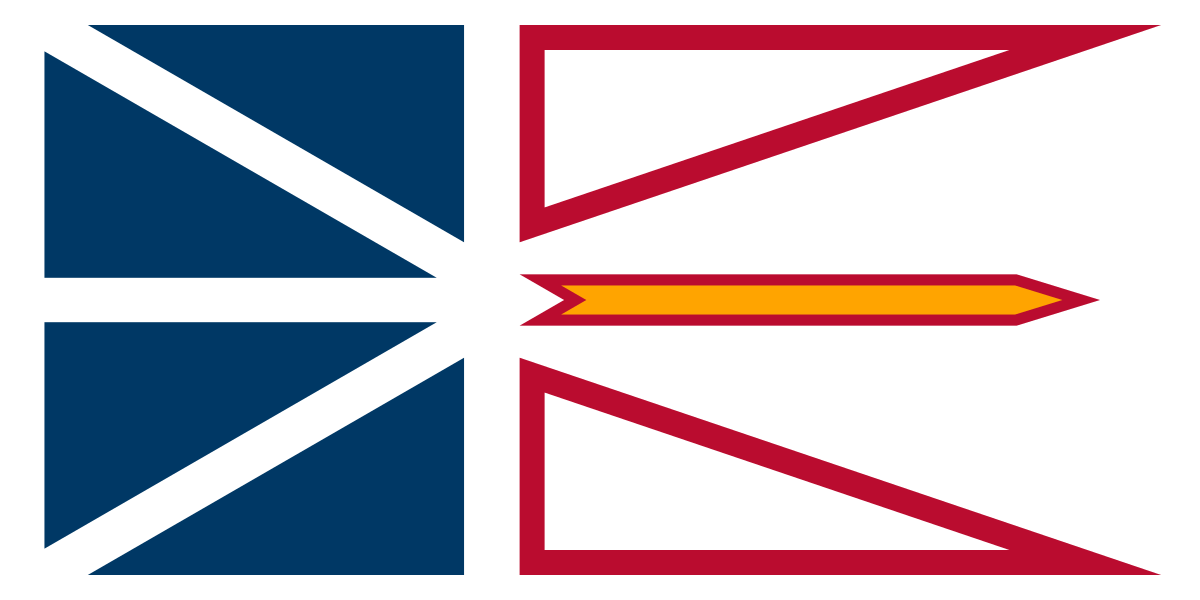
Newfoundland 
Newfoundland - Newfoundland

In Part 2 of the pirate "Black Bart" Roberts talk about his departure from Martinique to Newfoundland, having suspended the governor of the island in retaliation for having tried to capture. This island, known in Spain for Newfoundland was discovered by Italian Giovanni Caboto (John Cabot) in 1497 (1) . The Venetian by adoption, "the true place of his birth remains elusive, came to Venice 11 years, supposedly from Gaeta, while others say it was Castigione, in Liguria, it seemed, had heard about the discovery of" Indians "by Columbus and he therefore decided to undertake an expedition. Cabot's idea was simple: accepted the sphericity of the Earth, if started from a more northerly latitude, the length would be less, thinking, rightly, that the land would be closer together and shortening the trip considerably.
he traveled to England, where he presented his ideas at the King Henry VII, who gave his approval and financed the trip: "full and free Authorities, leave, and power, to Sayle to all parties countreys, and you, of the East, of the West, and of the North, under Our banners and Ensign, with five ships ... and mariners or men as Many As They Will Have in saide ships, upon Proper Their Own costs and charges, to seek out, discover, and finde, whatsoever iles, countreyes, regions or provinces of the heathen and infidelles, bee They whatsoever, and in What part of the world soever They be, Which Have Been Before this time unknow to all Christians. "
party previously had another trip in 1496, but Iceland was not due to disputes among the crew, which was forced to turn around. Cabot prepared his departure from Bristol, at the time the second largest port in England.

Cabot receiving the blessing before embarking on Bristol
With a crew of 18 men in one ship, the Matthew , was released on May 2, 1947 and arrived in Newfoundland on 24 June. The point is controversial arrival, fighting that honor several locations in the area, although the governments of Canada and the United Kingdom, after various investigations, it was officially granted it Buenavista Cabo. At the same time, it also grants have been the first European to reach mainland America (Columbus would not do until 1498, on his third trip) after the Vikings (2) .
 dedicated to John Cabot Statue Cape Bonavista.
 Anyway, one of the main objectives of the trip, which was to find the Paso del Norte (3) was not covered. The other was to find the mythical Island of Brazil that although it was not "exactly" found as a matter passed into the background, to intuit the true extent of discovery (4) . In return, the crew was alarmed by believing that they had traveled much farther north than it had done, Cabot urges steer farther south, fearing never to return to Bristol, the result was that happened long the British Isles and reached the French coast of Brittany . Back England was appointed Admiral and was rewarded with a pension. The following year he prepared a new expedition, this time with 5 boats, one of which broke down and stays behind in Ireland, starting days later, once repaired, to meet the rest of the fleet, and never be able to catch up again to be news of another 4 boats. Some assume that just went missing, while some say that Cabot was intercepted at sea by the English Armada by strict orders Isabel of Castile. The issue is that of John Cabot and his men were never seen again. Years later (1508), left his son Sebastian in search of the Northwest Passage and, possibly, some trace of his father, did not find any of those things. This trip of 1497 is considered by many as the beginning of British Colonial Empire.
Both the Canadian side and in English, are two towers dedicated to the late ocean, one in St. John `s (capital of Newfoundland) and the other in Bristol, as well as replicas of the boat lanes, the Matthew .  Cabot Tower in St. John's, Newfoundland ...
 .jpg) ... and its namesake in Bristol.
... and its namesake in Bristol. 

Above, a replica of the Matthew in Cape Bonavista, below, of Bristol.
After Cabot's voyage, French, English, Portuguese and some English fishermen were the first to go coming to Newfoundland. At the end of XVII century Irish settlers came to the place they called an TSIA Talamh - "land of fish", more or less, which gave rise to schools of fish in these waters and remain hiciesen famous. In 1583 it was claimed officially by Sir Humphrey Gilbert (5) as a British colony, traveling up there and meeting people of diverse origin, however, residents in any fishing season left the place after terminating his job. On the return trip, Gilbert was lost and stopped settlement schemes. In 1610 John Guy from Bristol with 39 other colonists for Cuper's Cove and found another settlement that was unsuccessful (6) . Island remained under joint control of France (southern and northern peninsula) and England (West) until 1713, the year in which France ceded to England full share by the treaty of Utrecht, keeping St. Pierre and Miquelon.
 Grand Banks
 Thereafter, any residents (seasonal fishermen) were systematically evicted by the English, but in the following centuries it was allowing the establishment of more and more people attracted by the growing fishing industry (of course) around the Grand Banks (7) .
The name comes from French Newfoundland Terre Neuve, while that of "Newfoundland" is one of the most old taken by Europeans to a Canadian, first appearing in 1502 and a letter clearly stated in a Ske ltonical the time (8) .
 Notes: (1) On the discovery of Newfoundland, like many of those born, especially in America, there is much discussion of authorship by Cabot. One of the arguments used is the existence of pre-travel portolans 1497, where these lands are represented. In most cases these claims made by Portuguese researchers (Annex º 1)
(2) Em these shores landed the Viking / Norwegian Leifr Eiriksson (970-1020), who, in accordance with narrated by Islendingesagaene - Sagas of Icelanders - came to Newfoundland to the 1003 (Annexes 2 º, 3 º and 4 º ). (3) El Paso del Norte was sought from the beginning of discovery, especially since the Basque Núñez de Balboa was found the Pacific Ocean in 1513. Since then sought the passage by sea that connect with the Atlantic, both the South and the North (Annex 5 º ). (4) Island Brazil was a mythical place that had never been found, traditionally located west of Ireland. In Annex 6 º details are given, in my opinion, very curious indeed.
(5) Sir Humphrey Gilbert (1539-1583) was an adventurer, explorer and parliamentarian English, brother of the famous writer and poet (also explorer and courtier) Sir Walter Raleigh. is thought to be the first to claim a property for England in North America. This topic is explained in his biography, to be published in the future in "The Pirate Ship." (6) In 1607 the Society of Merchant Ventures of Bristol obtained a license from James I to establish a colony in Newfoundland. J. Guy travels there and choose Cooper's Cave (now Cupids) as a place for settlement. After returning to the metropolis and get funding and approval of the proposed colony, undertook the journey mentioned in the entry with the appointment of governor of the new lands under his arm. Rest on two colonies, under Cooper's Cave and another in Renews. Once fortified, minimally organized both establishments, Guy returned to England in 1611, to get supplies and more settlers, if possible, a female contingent. Meets both, and again in 1612: what you find is that the settlement of Renews had been abandoned after an assault on the pirate Peter Easton, which made them decide to Guy in order to strengthen the fortifications of Cooper's Cave and abandon the idea one second settlement. Guy returned to England in 1613 and, as you know, never returned to Newfoundland, but left the foundations laid for the development and growth of the colony. This town of Cooper's Cave es el segundo lugar colonizado por los ingleses en Norteamérica, tras Jamestown, Virginia (E.U.A.). Right worshipfull,
yt may please you to vnderstand that...
the { documento rasgado } day of August we arrived (God be praised) all in safetie in the bay of Conception, in Newfoundland [in the] harbour here called Cuperres coue... This harbour is three leagues distance from Colliers bay to the Northeastward and is preferred by me to beginne our plantacion before the said Colliers bay fer the goodness of the harbour, the fruitfullnes of the soyle, the largenes of the trees, and many other Reasons ...
Middleton Manuscript My X 1 / 2. , University of Nottingham
(7) Grand These banks are large banks of sand covering an irregular seabed and found southeast of Newfoundland. Here you cross two opposing currents, both in direction and water temperature. This mixture, plus the materials that flow from the ocean floor, forming a nutrient broth suitable for the accumulation of marine fauna and therefore fish. Among the species found include the cod and similar ones, as the anon ( haddock) and capelin. Also notable is the amount of scallops and lobsters. At the same time, this concentration of fish attracts many birds and marine mammals: seals, dolphins and whales. In Annex 7 º may be some history of this place. (8) This little word used to name a type of verse from John Skelton (around 1460 -1529) of rhyme, meter and rhythm peculiar. The writer himself was given this name because it attributed its invention. Later, in the poetic language of England was to designate all those poems composed in a measure similar to that used by Skelton or used for free metrics. The Skeltonical about Newfoundland Newfoundland is the Governor Robert Hayman:
Skeltonical A Continued Ryme, in praise of my New-found-Land
Although in cloaths, company, faire buildings
With England, New-found-land not can compare: Did Contentment Some Know What I found there, Alwaye enough, MOST times Somewhat to spare, With little paines , toyle lesse, and lesser care, Exempt from taxings, ill newes, Lawing, Fear, If cleane, and warme, No Matter What You Wear, Healthy, and wealthy, if men carefull are, With much-much more, then I will now declare, (I say) if some wise men knew what this were (I doe beleeue) they'd live no other where.
-
-
- From 'The First Booke of Qvodlibets'
- Composed and done at Harbor-Grace in
- Britaniola , anciently called Newfound-Land
- by Governor Robert Hayman-1628.


.jpg)