Home Automation The importance of new technologies is, as we have been discussing, more and more important. We are faced with the continuous incorporation of new forms of communication in the industrial equipment, better equipment intended for domestic consumption ... every day we get different tools available to make life more comfortable while safe.
The use of these technologies in public buildings such as houses are called home automation. This term is used to denote the part of technology (electronics, mechanics and computer) that integrates existing elements in the house and controls and operate in coordination. Comes from the Latin domus and computer and according to the Royal English Academy covers all systems that automate the various facilities of a home.
Home automation is therefore the science that applies technological innovation in housing, providing such automation. The main advantages are 4:
1.) Improves comfort :
- Manage air conditioning: the system is responsible for maintaining the desired temperature in each room, so switched on and off automatically air conditioned. Additionally, you can tell the lack of fuel or any problems with the home automation system
- Lighting: There are various options for activation: through presence, schedule, and amount of ambient light, or by manual adjustment, since the switches have a regulator light intensity. In addition, you can choose an ideal light scene for each room, selecting the desired source, intensity and duration.
- Shades: has some buttons to raise or lower the blinds, but this function is self-managed weather conditions with strong winds and rains, closing windows, shutters, awnings and blinds down ...
- Centralization: This feature can turn off all lights and down all the blinds when you think evacuate.
2.) Brings greater security :
- Technical alarms: alert the user at a time that takes action to alleviate the problem. They are basically 3 types: A) In Flood: If the valves are located close to sources of water leak is detected, informs the user while cutting the water supply in the affected area B) gas leak: If the solenoid detects a gas leak, notify the user at the same time cut the gas supply automatically. C) Voltage drop: When the building is not current, the user can find a number of drawbacks, such as the thawing of food .. The system detects and informs the user.
- Fire since in case of fire is essential to the immediate arrival of firefighters, to detect, the system activates a powerful alarm to the time you call central station where firefighters are contacted.
- Theft: alarms are a deterrent, so that in case of intrusion or break windows of balconies or windows, the system calls the alarm center, which will send the police. At the same time, the system can run all the lights, or a combination thereof, inside or outside the home and closing doors and windows.
- Simulator of presence: the system turns on randomly lights up and down the blinds and even turn the TV to see that the house is inhabited.
- Medical Alarm: ideal for people with serious illnesses or diseases or elderly. If the individual foresees problems only have to activate a device worn as a pendant or wristband and the system calls to a medical facility.
3.) New forms of communication:
- Remote connection to equipment, from any phone (fixed or mobile ...) to connect to the automation system to enable or disable the desired services, in the same way that the system calls in case of accident or danger. Also You can open the door by remote control.
- Distribution of audio and video: you can make the music player located in a room is heard throughout the house or watch television signal video intercom.
- Telematic networks: These networks allow you to perform a variety of activities without leaving home, such as home shopping, financial transactions, send messages to anyone in the world ... daily options are extended.
4.) Reducing energy costs :
- Double rate: the utility companies offer two rates, the night that saves up to 55% in kW / h. So, you can set the home automation system to suit the evening and connecting certain appliances (such as washing) overnight, or that accumulate heat energy at night to release later in the day.
- build system: energy stored in the time slot most economical and distributed over the rest of the day, usually in the form of heat because they are easy to find heating or water heating. This process is done programmatically and using timers.
- Rationalization of consumption: are intended to disconnect a portion of non-core circuits for power consumed does not exceed the contract, which would lead to a disconnection of all circuits. This system allows for both hiring a smaller amount of power, thereby reducing recruitment costs.
- Air conditioning are grouped the different rooms of the house into two types, depending on when frequenting more, night or day. Thus, the system is responsible for changing the temperature for each of them, for example by increasing the temperature in the rooms at night and reducing the room.
- Lighting: Using sensors, you can scale the intensity of the light automatically turned on or off if it is unnecessary to consume the least amount of energy without causing any discomfort to the user.
- Phone calls can prohibit the system as they are intended for urban, metropolitan, national, international or mobile so we can prevent abuse of the equipment if the owner not be present. In turn, limit the duration of the call, and block outgoing calls so that they can only receive calls.
- Statistics: The system collects a series of data and store certain information, then the user can view, obtaining data on the consumption of light or phone, where there has been a problem, what was the cause ...
system Home automation is composed of three fundamental elements :
- Sensors: are responsible for capturing any kind of physical change within the home and transmit the information to the control unit for it to act accordingly.
- Actuators: These are the devices by orders that gives control unit, acts and transforms those data with physical actions (up shutters, make a call ..)
- Control unit: is the most important system, which is responsible for managing the information and send the necessary data to the actuator to solve the problems. Tends to have the necessary user interfaces to present information to this (screen, keyboard, monitor, etc.).

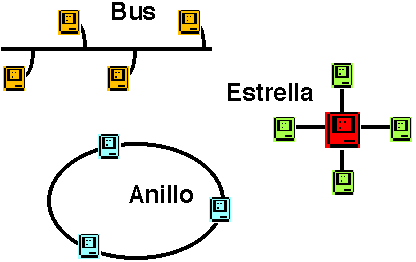
After seeing the components of control systems would have to discuss the ways in which they can be interconnected. The distribution of the elements of the type of system is called the network and can be 4 types: star, bus, ring or mixed. Each has its advantages over others: those centralized designs in which different systems send information to a central core, are more effective and faster, especially the star system, but have the disadvantage that if fault core, the whole fault. This does not happen in a distribution ring, since the fault affects only one system and others continue to operate normally. With the type Bus, information input and output flows through a single cable, which facilitates the installation of equipment. The mixed type has two types of design and is used in complex systems with many systems, which can be grouped according to function performed and then link to a nucleus to ensure efficacy.
Depending on the characteristics, the home automation system can be used:
- Decentralization: sensors and actuators have a little self-control systems adapted to enable direct interaction between them.
- Centralized: all sensors are connected to the inputs of the control unit and actuators to the output. Therefore, all information is controlled by the central unit receives data from the different parts of the system captures, manages and is responsible for all modifications. To control using a control module, which is programmable and responsible for transforming the information from the tickets depending on the schedule that you have made.


can also classify plants in two types:
- Central Wired: all sensors and actuators are connected by wiring to the central main controller for the entire system. Normally has a battery backup, allowing run for hours in case of power failure.
- wireless stations: the connections are using wireless sensors powered by batteries or batteries and transmit information via radio to the control unit which is mains powered and has its own battery backup.
- Central mixed, combined with wireless wiring.

The system can be operated manually on the control panel (usually positioned at the entrance of the house) or by a series of codes of type * 0 # making a call from any touch-tone phone (DMTF).
Provide a home for an automated system using the features mentioned, involves an investment of 18,000 euros. The appliances are needed to conduct specific, although a number between 600 and 1000 euros can turn the air conditioning and alarm system.
The system evolution is marked by the evolution of electronics and computing. At the end of the decade of the 50 use computers transistor marked the beginning of smaller teams, fast and versatile machines that allow the valves.
Ten years later, shows the integrated circuit (IC), which enables the manufacture of many transistors on a single silicon chip.
mid 70's the microprocessor becomes reality. Displayed the first systems capable of direct digital control (DDC).
In the early 80's appears the personal computer. The one of the microprocessors is extended and will cost significantly reduced.
At the beginning of the 90 displayed the first control systems with BUS technology and from there begin to evolve in a manner similar to that of computers personal: it is not important that the well control equipment, but it is essential to be able to easily show the hundreds or thousands of data they use. With the advent of graphical operating systems Windows 3.x, Windows 95 and beyond, the systems become something easy to use an operator.
words, home automation applications combine a variety of applications in electronics and computing, so that progress on these will cause changes and improvements in home automation systems, making it a completed application nothing but a optimum position for further growth.
And despite all the possibilities of home automation offers knowledge by the population of this system is still very limited, and the study of this innovative application in the construction sector, very low.
 As you know, today I attended the conference featuring Don Joaquín Almunia, under "Factors success in a global economy. European strategy. "