Although this neologism, a cast of English New Economy, is a very difficult concept to define, because it is multifaceted and enclose a thousand shades, you could say that refers to the new way to produce after the revolution technological advances, especially those related to computer and internet and involving the basis of productivity and competitiveness. In this first approach to the concept could be drawn that throughout history has been "emerging economies" as referred to economic change, social and productive after a revolutionary new technology.
The greatest exponent of this revolution is undoubtedly the United States, reaching, in 2000, 107 months of growth phase, characterized by full employment (a rate of structural unemployment or NAIRU [see ANNEX] of 4% of the workforce), a CPI increase of only 2.3% and a GDP growth of 4.5%. To this must be added the government surplus, the trade deficit and the balance rising current account, historically high stock prices and the continued appreciation of the dollar. This led to the savings rate to zero and even negative levels as it also specializes in this country more effectively monetize the savings of others.
This was possible not only through the development of Information Technology and Communication as is commonly believed, but also by technological progress . The acceleration of technological progress coupled with increased investment in ICT led to a significant increase in nonfarm productivity. This led to changes in management companies (greater organizational flexibility, redefining optimal size of firms, thus reducing cost-), \u200b\u200bless aversion to invest, better risk management, new forms of organization, improvement of production techniques, marketing and distribution .. . which represented an acceleration of productivity growth. In view of the results caused by the TIC (the growing importance and increased computing power, cheaper technologies together with higher performance, increased productivity generated by them, the intensity of investment in them) there were spillover (referring to the ability to increase investment yields for the realization of other similar investments. That is, for example, internet would not be so important if there in isolation for some people, but it is precisely the interconnection of millions of people that gives its importance).
The acceleration of technical progress in high technology industries and the significant increase in investment in information technologies led to increased productivity, leading to an increase in aggregate supply, reducing unit costs and a reduction in inflationary pressures. This made the risk of excessive tightening of monetary conditions decreased significantly.
The overall result was a significant increase in per capita income, leaving obsolete the idea that the risk of inflation would limit the possibilities of economic expansion. Therefore, he described the United States, or this new way to produce and operate, "New Economy", "New Paradigm", "Information Age" or the "Knowledge Economy."
For Europe to a position at the U.S. would require a significant investment in physical capital, but even more in knowledge (I + D + i) technological capital and, of course, human capital and that this new era is a requirement higher learning as to be an overload, what prevails is the ability to manage it.
ANNEX:
The acronym NAIRU from Non-Accelerating Inflation Rate of Unemployment (unemployment rate accelerating inflation) and refers to structural unemployment: that that despite the improved economic conditions will not go away. Not constant in time, but varies according to the law, the behavior of agents ... When far from diminishing, increases, is called hysteresis.
The idea emerged in the late 70's when neoliberal economists such as Friedman or Phelps jointly analyze data of unemployment and inflation United States and feel that these two variables are inversely related, so that increasing one, the other decreases. They conclude that the unemployment rate tends to the same level of "equilibrium", which is only away when policymakers force a reduction in inflation.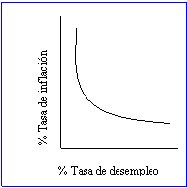
graphical representation par excellence of this phenomenon is
Phillips curve and the evolution can be seen on the link below
http://www.aulafacil.com/Macro/Lecc-23-2.gif
Bibliography:
"The economy in the network. New economy, new finance "by Emilio Ontiveros.
The greatest exponent of this revolution is undoubtedly the United States, reaching, in 2000, 107 months of growth phase, characterized by full employment (a rate of structural unemployment or NAIRU [see ANNEX] of 4% of the workforce), a CPI increase of only 2.3% and a GDP growth of 4.5%. To this must be added the government surplus, the trade deficit and the balance rising current account, historically high stock prices and the continued appreciation of the dollar. This led to the savings rate to zero and even negative levels as it also specializes in this country more effectively monetize the savings of others.
This was possible not only through the development of Information Technology and Communication as is commonly believed, but also by technological progress . The acceleration of technological progress coupled with increased investment in ICT led to a significant increase in nonfarm productivity. This led to changes in management companies (greater organizational flexibility, redefining optimal size of firms, thus reducing cost-), \u200b\u200bless aversion to invest, better risk management, new forms of organization, improvement of production techniques, marketing and distribution .. . which represented an acceleration of productivity growth. In view of the results caused by the TIC (the growing importance and increased computing power, cheaper technologies together with higher performance, increased productivity generated by them, the intensity of investment in them) there were spillover (referring to the ability to increase investment yields for the realization of other similar investments. That is, for example, internet would not be so important if there in isolation for some people, but it is precisely the interconnection of millions of people that gives its importance).
The acceleration of technical progress in high technology industries and the significant increase in investment in information technologies led to increased productivity, leading to an increase in aggregate supply, reducing unit costs and a reduction in inflationary pressures. This made the risk of excessive tightening of monetary conditions decreased significantly.
The overall result was a significant increase in per capita income, leaving obsolete the idea that the risk of inflation would limit the possibilities of economic expansion. Therefore, he described the United States, or this new way to produce and operate, "New Economy", "New Paradigm", "Information Age" or the "Knowledge Economy."
For Europe to a position at the U.S. would require a significant investment in physical capital, but even more in knowledge (I + D + i) technological capital and, of course, human capital and that this new era is a requirement higher learning as to be an overload, what prevails is the ability to manage it.
ANNEX:
The acronym NAIRU from Non-Accelerating Inflation Rate of Unemployment (unemployment rate accelerating inflation) and refers to structural unemployment: that that despite the improved economic conditions will not go away. Not constant in time, but varies according to the law, the behavior of agents ... When far from diminishing, increases, is called hysteresis.
The idea emerged in the late 70's when neoliberal economists such as Friedman or Phelps jointly analyze data of unemployment and inflation United States and feel that these two variables are inversely related, so that increasing one, the other decreases. They conclude that the unemployment rate tends to the same level of "equilibrium", which is only away when policymakers force a reduction in inflation.
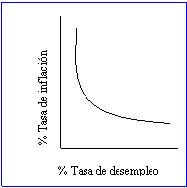
graphical representation par excellence of this phenomenon is
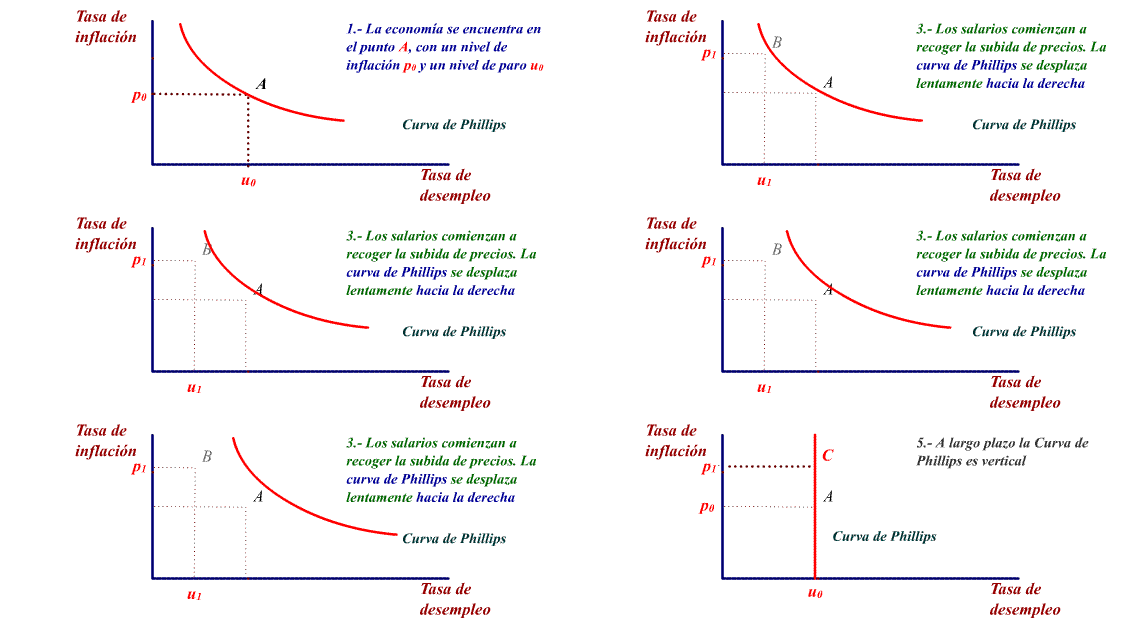
Phillips curve and the evolution can be seen on the link below
http://www.aulafacil.com/Macro/Lecc-23-2.gif
Bibliography:
"The economy in the network. New economy, new finance "by Emilio Ontiveros.


0 comments:
Post a Comment