 Globalization has appeared in our lives as a phenomenon that nobody can be outside. While the economy has been "globalized" from the beginning of time (trade relations have grown steadily, payment methods have evolved to facilitate trade, countries specialize in what they knew to do better ... ) the idea of \u200b\u200ba global world now becomes heavier due mainly to improved technology that has turned the planet into a mass of interconnections that the Internet has been the main tool.
 The globalization is considered, in the words of IMF the growing interdependence of all countries in the world caused by the increasing volume and variety of transactions in goods and services, as well as international capital flows, while the widespread diffusion of technology . If we break down this definition, on the one hand, the increasing interdependence. Today, a company can not act in isolation without considering the impact that their decisions will have on its competitors not only in their own country but also from other countries. Countries have come to realize the importance of enhancing relations and grouped to gain more weight in decisions in supranational institutions. As examples, any process of economic integration: the MERCOSUR, the Benelux, the European Union ... In them, members gain an advantage by lowering tariff barriers by eliminating the costs of covering the risk of exchange rates (and costs disappear conversion of currencies), to access a wider market (segmentation disappears markets and price discrimination), to increase competition by obtaining lower prices for consumers, promoting modernization of enterprises ... This is because the second portion of the definition: international capital flows. Tas World War II, trade and productive investment expanded significantly. Productive capital is internationalized and expanded in the form of direct investment, mainly made by large U.S. corporations. International financial flows were boosted by the disappearance of the rules governing capital movements, the emergence of new financial instruments and agents and the availability of new technological developments. These advances allowed to conduct business in a few seconds, so that financial transactions be moved to anywhere in the world. Great facilities for investment did emerge thousands of speculators who sought to get rich simply by buying and selling of currencies usually very short-term operations. Therefore, some economists defended the idea developed by James Tobin in 1978 to implement a rate that taxing financial transactions. According to Tobin himself declared in an interview published in Der Spiegel, the rate (of a low percentage of transaction volume) deter speculators, which would be a benefit because if the funds provided by these suddenly withdraw "the countries must dramatically increase the interest for the currency remains attractive. But high interest rates are often disastrous for the national economy, and have highlighted the crisis of the nineties in Mexico Southeast Asia and Russia. My return rate leeway to the central banks of small countries and oppose the dictates of some financial markets "[See Annex] The ultimate deciding factor of globalization is technology, especially that associated with microelectronics, computer and telecommunications, followed by other no less important although less related to the topic at hand such as biotechnology, genetics or pharmaceuticals. The so-called Information Technology and Communication (ICT )-one can differentiate these two concepts: while the information is up all data relevant when making a decision, communication, according to wikipedia, is "the process of sending and receiving messages" between individuals, which means that at least two people are related to take-out found its greatest exponent in internet. Internet is a network of networks that connects millions of computers using the same protocol (TCP / IP) worldwide. Expansion by firms and households has become one of the most important media, and that its release is immediate and accessible anywhere in the world. This is a global network of instantaneous transmission of ideas, value judgments, data, reports, work ..... Thanks to advances in telematics, the channels of transmission have been improved increasingly allowing greater access to knowledge. It is estimated that in 2000, 327 million people had Internet access and can share expertise 24 hours a day. However, 82% of these users are concentrated in 15 countries, the highest percentage belonged to the United States. We are thus faced with a huge variety of options at our disposal with a minimum investment: just a computer and a telephone line with internet access. It is then at this point that opens a new debate: what happens to people who lack these requirements? People, regions and even entire countries fall outside this range of possibilities. To this has been called "digital divide " and is due to technological and educational differences.

This, far from fostering the convergence between countries would enhance 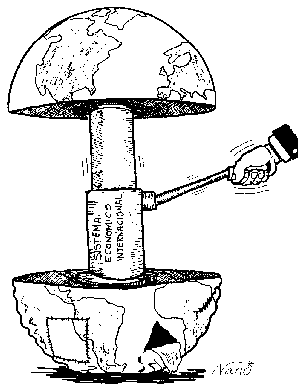 difference between poor and rich countries (developed and developing). According to Peter Marcuse , technological advances are associated naturally with the increasing concentration of economic power. According to Professor Colombian "computerization, streamlining of communications, thanks to advances in information technology, the ability to exercise and radiate from a central control to the five continents, the growing speed and efficiency of transportation (both goods and people), the ease of flexibility production, and automation of routine tasks are in fact essential to the substantial increase in the concentration of economic power we are witnessing today. "
At this point, had to mention the various advantages and disadvantages that emerge from this process:
- Globalization as is being done now encourages homogenization people, about cultures, races, languages, ethnicities, religions ... creating a global village, lacking such as the current heterogeneity. This can be seen as a negative factor if you are attempting to defend their collective cultural identity and do not want to be part of this process. On the other hand, can be a positive factor if it increases understanding among peoples, reducing conflicts, civil wars ...
- Globalization gives companies a lot of information about the course of action to be taken, both inside and outside the company: the environment to be implemented in the workplace, the treatment that employees receive in other companies, shares undertaken by competitors, new market potential, contact with potential suppliers with those obtained raw materials at lower cost, without businesses that can be created within the Internet. This benefits the most competitive companies that are expanded its customer base and harms the least well adapted, so that we could say that this is a simple system of natural selection (which lost the buffalo herd that less harm to the buffalo run but benefits the rest that can increase your pace). With this opening outward away companies not being competitive subsisted on purchases obtained from nearby industries. On the other hand, expand the market, products are more varied and, by increasing competition, prices are lower. In conclusion, globalization benefits consumers and harms businesses less competitive.
- The extensive information available and the disparity in labor and natural resources of countries have led to the birth of a process called offshoring is the site of a fraction or the entire production process in countries which are expected to certain advantages. This process has been conducted mainly in Europe and the United States to Asian countries and Eastern Europe. The beneficiaries, consumers in obtaining lower prices, companies saw their profits increased, host countries by creating jobs mild, the disadvantaged, low-skilled workers of those companies that are replaced by others in the destination countries. I will leave this parked the subject since its importance and magnitude will be discussed further in a future post.
- Progress in the area of \u200b\u200btelecommunications have increased exploitation (in the positive sense) of the capacities of man, which has propelled the requirements of the companies at the time of recruitment are growing. This hurts workers with low levels of training and as the segment of the population not born in the information age and thus are more reluctant, skeptical or clumsy in adapting to new technologies (in this case the digital divide has a strong generational). Benefits to companies with better human capital adopt a higher level of enforcement, and also benefits the whole country, because from my point of view, more training, intelligence, culture ... of a population, the greater its development and thus its per capita income. On the contrary, it harms the groups mentioned.
- Apart from outsourcing, globalization has led to specialization countries in those industries, business or tasks that are more competitive given its natural resources, their pay structures, conditions of work ... So many corporations have become fragmented and spread throughout the world through subsidiaries, among which comprises the production process (which can lead to higher costs of coordination and possible repatriation costs). Now the comparative advantages arise from the ability to innovate, adapt, adopt, imitate or improve technology, which is a disadvantage for Spain, since it is one of the EU countries that uses fewer resources in this area, just above Portugal. While in recent years there has been an effort tecnológico (pasando de una inversión en I+D en proporción al PIB de 0‘55% en 1985 al 0‘9% en 1998), el aumento nos ha llevado a converger, pero a mantenernos lejos de la media. La principal explicación que podría darse es la composición empresarial del país: aproximadamente el 90% de las empresas son pymes, las cuales no suelen destinar recursos a tal efecto. Por ello, en España, sólo el 2’25‰ de las empresas realizan actividades de I+D. Para 1998 el gasto total el I+D en relación con el PIB era en España del 0’9% muy alejado del 2’74% de EEUU o del 3’06% de Japón, sin duda a la cabeza del proceso tecnológico. Pero si make a more realistic comparison, by looking at neighboring countries, the result is more hopeful: 2'29% Germany, France, 2'18% 1'83% United Kingdom, Italy 1'02% ... And the European average 1.81%, ie, exactly twice that in the English case. Needless to say, the government must take action on the matter: whether the companies alone can not "pull the car" in innovation, public expenditures should give a boost, or at least create a favorable environment, as would be: central research building funded by several SMEs to undertake a joint research process, promoting increased sized enterprises in order to decrease the proportion of SMEs and increase the number of those who can invest, to encourage SMEs to use public transport through contractual relationships with universities and local businesses and encourage international cooperation between domestic SMEs and foreign countries through bilateral agreements with the mediation of the governments involved ...
The EU believes that no new technology there is no growth. With them, there has been a net job destruction of low-skilled (and be less efficient or more expensive to buy a machine with adequate technical support) together with an increase in demand for workers technological skills. Contrary to expectations, create jobs with new technologies.
- Internet allows consumers access from anywhere in the world, so benefit from a fully accessible space limited or temporarily not being able to buy 24 hours a day comfortably and easily. This also benefits businesses that have the loyalty of consumers who get their sales regardless of their location. In addition, purchasers a decrease in search time and can quickly compare prices and qualities.
- Globalization also has effects on the ecosystem: technological changes have brought a revolution by requiring the use of certain materials which could lead to depletion of resources. Therefore, the investigation of new materials becomes an important role. A good example is the optical fiber. It consists of a fiber or glass rod, or other transparent material with high refractive index, which is used to transmit light (when light enters one end of the fiber, is transmitted with very little loss even though the fiber is curved). If we look back, see how the first studies on this material were made by Holger Moller Hansen , who in 1951 tried to patent his idea in Denmark. Knowing they were the first studies of this type mean that were not included in the state of the art. In addition, because of its novelty should meet the second requirement for patentability of inventive step. I therefore consider that the patent was rejected by not find "industrial applicability." Later in 1954 Abraham Van Heel, Harold H. Hopkins and Narinder Kapany studies carried out individually on a fiber optic and although none were produced that will revolutionize optical fiber. Later, in 1966, under the aegis of the Institute of Electronic Engineering (IEE), Charles K. Kao showed that the experimental optical waveguides were information capacity equivalent to 200 TV channels and more than 200,000 telephone lines. Since these fibers had leaks, the researchers tried to purify the compounds of the glass. Meanwhile, other (which is Robert D. Maurer doctorate in physics from MIT) began working with fused silica. This obviously causes significant changes in material requirements. Donald Keck said in 1999, "would require 2 metric tons of copper wire to transmit information that can be a little over 1 lb of fiber. In lab today, a single fiber can transmit the equivalent of 60 million calls simultaneous phone. " To be specific, the substitution of raw materials, food, metals and minerals can harm the countries specializing in exporting them.
- Last but not much less important, one should also consider the environmental impact. The current economic growth model practically does not respect the environment. Therefore, the economy should be aimed at making a growth commensurate with sustainable growth, ie one that uses existing natural resources without mortgaging future generations.
As we can see, globalization involves many and varied aspects, many nuances, many causes and effects, therefore, the study that we make in this regard must be thorough and meticulous, to finish can be defined with greater precision and criticize or praise him knowingly.
ANNEX: TOBIN TAX 
tax consists of financial market transactions. The proposed professor at Yale University and Nobel laureate economist James Tobin in 1972 to reduce currency speculation. I thought that would help the countries' monetary authorities to regain autonomy in financial markets as a tool to dampen fluctuations in change given the obsolescence that would mean today fluctuation bands for exchange rates. Thus, small countries would find themselves at the mercy of speculators, but would have a little leeway with which could have been averted or muted crisis as Southeast Asia, Russia and Mexico. And it was this claim: the tax revenue that this tax would generate are considered a "byproduct". Therefore, does not identify with the anti-globalization movement, which believes that abuse their name. It is not against the money raised goes to help a good cause, one that argues that this is not the purpose of "their" fee.
basically interested in the proposed raise funds for development aid. Thus, taxing financial activities carried out by wealthy individuals with a basic level of life insurance, would seek to reduce the gap between rich and poor, by converging to different countries around the globe. However, according to Martin Wolf , the money would not be used promptly as they questioned how they could permanently finance a transfer from rich to poor. Wolf finds it impossible to fund this objective and not considered feasible to organize the collection of such funds, given the market volatility Financial. In addition, to carry out the collection would have to create a global tax jurisdiction, although this was technically possible, it seems irrelevant, since it would have to get the consent of all governments.
 The position defended by Susan George (and movement ATTAC -Association for the Taxation of Financial Transactions for the Aid of Citizens-) is the application of the fee to combat speculation, vision something closer to what Nobel laureate James Tobin proposed in his day. The rate is set at around 1% and would apply to all transactions. As the associated transactions a genuine commercial transactions are 2% or less, the fee would penalize only very few of those working in the real economy. However, most affected would be those made by the traders and their operations are conducted at very short notice. According to page http://tobintaxcall.free.fr , with only 0.05% "rate would seek more than 100,000 million dollars a year, which could be used to stabilize the currency, to develop the economy, finance humanitarian aid to alleviate other national or international crisis "
And finally, my personal view. I think several things: I think rate according to the idea of \u200b\u200bthe author not slow down too much financial transactions, since the traders would be affected profits in a very small percentage of what, in my opinion, not discourage investment, I think raising the rate would be an arduous task (although there are people who consider it very simple ), I think it would be very difficult to reach a global consensus that all countries would join the cause, since countries would as always position themselves as tax havens, and I think even more thorny is the question of the use of the collected capital, we have organizations like the IMF and World Bank who have spent decades dedicated to these aspects are not always welcomed (the same James Tobin defends saying it is the lack of resources, which makes their actions are not the most appropriate) should we let them try to wash your name or create a new institution?, on the other hand, like any other tax, is paid to the fraud ... and that there are countries more likely than others ... In addition, we ensure that this measure would have the fiscal and social benefits expected? traders are not invent these new ways of investing that dodge rate?
Bibliography:
Large areas of the world economy, and María Jesús Enrique Palazuelos
Vara Liberal globalization, Martin Wolf and Susan George
http://www.inisoc.org/dourson.htm
http://www.eumed.net/cursecon/textos/tobin-antiglob.htm
http://es.wikipedia.org
http://www.portalgsm.com/


0 comments:
Post a Comment